
Executive Summary

Edition updated August 13, 2026. Original publication October 2025.
AI SEO, the umbrella for Answer Engine Optimization (AEO) and Generative Engine Optimization (GEO), is the discipline of earning citations in AI-generated answers across ChatGPT, Copilot, Perplexity, Google AI Overviews, Claude, and Gemini. What people call AEO or GEO is an evolution of SEO, not a separate discipline: traditional SEO surfaces brands in search results, and the same crawlable, authoritative, genuinely helpful content now surfaces them in the synthesized answer. What changes is the depth of execution, particularly the net-new information gain AI retrieval rewards. Dan Petrovic's reverse-engineering of the grounding pipeline reaches the same conclusion from a different evidence base: "LLMs have not replaced search. They have simply changed its surface" (Dan Petrovic, DEJAN, September 2025). The MERIT Framework organizes that work across five pillars and fifteen chapters.
The MERIT Framework
The Five Pillars
Third-party validation across trusted platforms in your industry where AI systems discover authoritative signals about your brand, products, services, and expertise. Verified customer reviews on review and directory platforms, authentic community engagement on forums and social communities, strategic third-party publications and media coverage, consistent web presence across multiple channels, and other external validation that builds credibility. AirOps's analysis of 21,311 brand mentions across more than 500 commercial-intent queries puts the premise on the record: 85% of brand mentions come from third-party sources rather than owned domains. Kevin Indig's separate study corroborates that third-party dominance and adds a refinement, that the share rises the closer intent comes to purchase (Kevin Indig, Growth Memo, January 2026).
Original, quantifiable assets that establish your brand as a primary source AI systems can reference and attribute. Proprietary research and benchmarks, case studies with measurable outcomes, expert analysis and educated opinions, evidence-based frameworks, transparent methodologies, and other authoritative resources that show thought or industry leadership. A 2023 academic study, FActScore, frames what a citable evidence claim looks like in this medium. Min and co-authors break a long AI answer into single facts and score each against a trusted knowledge source.
Comprehensive, intent-aligned content structured for AI retrieval in self-contained, citable segments. Answer-first content architecture, question-based headings, passage-level structure for retrieval-augmented generation (retrieval systems internally segment content; this is sometimes called chunking), semantic HTML structure with clear topical boundaries, pillar-and-cluster strategies, multi-format presentation, and related techniques that improve extractability. Google Research's ScaNN paper grounds the retrieval premise: the system returns the items with the highest inner product, the substrate that decides what becomes a candidate for the answer. Items not in that top set never reach the model.
Technical accessibility and semantic precision that enables AI crawlers to discover, understand, and correctly interpret your content and entities. Proper crawler configuration, entity schema, knowledge graph connections, IndexNow and Google Indexing API integration, semantic markup, server-side rendering, and other technical optimization that ensures machine readability. Google Research's Knowledge Vault paper from 2014 names this layer at web scale: a system that fuses entity facts from text, tables, page structure, and human notes into one probabilistic knowledge base. The entity layer is the substrate search engines build so retrieval can tell who is who.
Systematic measurement, organizational evolution, sentiment management, and continuing optimization that sustains AI visibility through volatility and change. Weekly monitoring with volatility awareness, monthly trend analysis on moving averages, quarterly strategic reviews, realistic expectation management, the Sentiment Footprint that measures brand sentiment across four layers before the Sentiment Shaping work that moves it, and the team structure required for sustained execution.
MERIT is the strategic framework. Corpus Engineering is the operating discipline beneath it: a systems-level practice for engineering a corpus for retrieval, semantic understanding, citation, ranking, and AI generation. Inclusion is Corpus Engineering at the accessibility and entity scale. Relevance, at the passage and sub-corpus scale. Evidence, at the information-gain and asset scale. Mentions, at the extended-corpus and expansion scale. Transformation, at the lifecycle and maintenance scale.
The 2024 RAG survey from Gao and co-authors states the case plainly: retrieval-augmented systems pull chunks from an outside base before they write the answer, and the step cuts the rate of false output. Corpus Engineering is what makes that step land on the right chunks.
The Fifteen Chapters
Each chapter distills the strategic case and points to the corresponding chapter in the MERIT Framework Playbook for operational depth and worked examples. Searchbloom-coined diagnostics run underneath the framework, one or more per chapter, turning judgment calls into calculable numbers: Information Gain Density and Information Gain Score for substance, the Retrieval Surface Multiplier for structure, the Entity Authority Score and Bot Access Health Score for machine readability, the Outlet Citation Weight Index for placement value, and the Citation Share Variance Coefficient for reading volatility. The Playbook carries each one with formulas and scoring bands.
Mentions
Chapters 1 to 3Third-party validation on the surfaces AI systems already trust.
Pay-to-Play Placements
Review and comparison platforms are where AI systems look first, and placement on them is purchasable. The work is placement plus review velocity, not a logo in a directory. Three operating tiers cover most situations, and sustained presence on two platforms is the working pattern for mid-market brands. 90% of third-party AI citations come from listicles and review-platform comparison pages, with 80% of cited brands in the top three spots.
Community Mentions and Positive Sentiment
Reddit, Quora, LinkedIn and the niche forums in your category are read as evidence of what real users think. You earn that by participating, not by posting. The 90/10 value-to-brand-mention rule and the platform reputation thresholds are non-negotiable, and a named operator has to lead it. Brand accounts earn a fraction of the lift operator-led work earns, and full outsourcing fails because community surfaces detect inauthenticity fast.
Third-Party Corroboration
The editorial layer: getting written about, quoted, and listed by people who are not you. Four channels carry it. Contributed pieces, listicle placement, podcasts and speaking, and expert sourcing that gets a named executive quoted in someone else's article. Working cadence is three to six contributed pieces per quarter per named expert. Analyst reports are largely unreadable to AI crawlers, so treat an inclusion as something to make retrievable elsewhere.
Evidence
Chapters 4 to 6Original substance that makes you the primary source worth citing.
Original Source Asset Development
What you publish that nobody else could. Five asset types earn citations: frameworks, opinion, research, calculators, and templates. AI cites opinion as readily as research when the source has verifiable expertise, so pick by matching asset type to your expertise and to what the category's cited content lacks. A planned mix of assets beats one big asset almost every time.
Information Gain Architecture
The mechanism behind Evidence. AI retrieval filters for substance the model has not already seen a thousand times, so the question is not whether a page is good but whether it is new. Searchbloom measures that two ways: Information Gain Density counts distinct insights per page, and Information Gain Score checks the page geometrically against what already ranks. B grade, 0.35 and up, is the production target.
Citation Reinforcement and Topical Clusters
Single assets stall. Clusters compound, because AI retrieval is entity-aware and the second asset on a topic gets cited at a higher rate than the first. One hub plus four to nine spokes is the working range. Depth beats breadth. Refresh cadence differs by content type: quarterly for benchmarks, annual for frameworks, and reactive on a real trigger event.
Relevance
Chapters 7 to 9Structure that lets retrieval find and lift your answer.
Answer-First Content Architecture
AI retrieves passages, not pages. A page that buries its answer under an introduction is invisible to retrieval no matter how good the substance is, so every section leads with the answer and elaborates after. Four structural elements do most of the work: FAQ blocks, lists and tables, question-based headings, and numbered procedures. Answer-first pages earn 2 to 3x the citation share of pages that make the reader wait.
Multi-Format Surface Coverage
The same substance published as text, video, image, structured content, and audio gets retrieved five ways instead of one. Video is the format most brands skip and the one AI Overviews reach for most, with YouTube appearing in 29.5% of them (BrightEdge, October 2025). Pair every video with an edited transcript on your own domain, because the transcript is what retrieval reads. Pages carrying three or four formats earn materially more citation share than single-format pages.
Semantic HTML and Entity-Rich Language
Schema is important for traditional SEO and it does not reach the model. LLMs do not parse markup at generation. Search engines read it, and retrieval draws on what they build from it, which makes the effect real and small. The lift people credit to FAQPage schema comes from the visible question-and-answer structure. What does move attribution is naming entities in full at the sentence level.
Inclusion
Chapters 10 to 12Technical access and entity precision, so machines can read you at all.
Entity Optimization
AI retrieves by entity, not keyword, and it breaks a single question into 10 to 20 subqueries before it retrieves anything. Four entity types run in parallel: your brand, your people, your products, and the topics you want to own. The named-expert pattern turns a founder into an entity AI can cite. Wikidata is the structured backbone, and a Knowledge Panel gets claimed the day it appears.
Crawler Access
The cheapest failure in AI Search, and the easiest to fix. One bad robots.txt line blocks the crawlers and every other pillar stops paying. Split training bots from retrieval bots from user-triggered fetchers, always allow the last two, and for most mid-market brands allow training as well. Google-Extended belongs in the allow set: it governs Gemini grounding, not just training, and blocking it buys no control over AI Overviews.
Indexation, AI-Bot, and Agent Readiness
The access, verification, and freshness layer for AI retrieval. Robots rules and meta robots govern which crawlers reach a page and how it gets indexed; Web Bot Auth verifies the AI bots that arrive and turns away impostors; content-use signals declare how the content may be used. IndexNow and Google's scope-limited Indexing API push recency into the indexes fast, a freshness lever rather than a citation one, and recently updated pages earn 3x the citation share of older ones. It closes with an honest read on the agent-readiness horizon and why most of it is a separate discipline from getting cited.
Transformation
Chapters 13 to 15Measurement, reputation and the org built to sustain the work.
Measurement Cadence and Expectations
AI Search is probabilistic, so a point-in-time rank check measures noise. Rank inside AI recommendations is statistically random in over 99% of measured cases while the consideration set holds steady, with leading brands still recurring in 55% to 77% of responses, which makes citation share across rolling windows the only honest metric. Three cadences carry the engagement: weekly for technical health, monthly for citation share, quarterly for strategy. Six KPIs, and expectations set for a multi-cycle horizon.
Sentiment Footprint and Sentiment Shaping
AI reconstructs your brand from every public surface at once, so an inconsistent story produces hedged output and a wrong story produces a wrong answer. Measure before you act. The Sentiment Footprint reads sentiment across four layers, then Sentiment Shaping moves the layer that is dragging. The correction lever is always the source, never the AI output. Retrieval-baked errors clear in days; training-baked errors wait for the retraining cycle.
Organizational Evolution
Marketing is becoming engineering, and an engagement run as a campaign will not hold. Five functional roles carry MERIT: Engagement Lead, Content Lead, Technical Lead, Distribution Lead, and a Named Expert. Three team structures fit different scales, and vendor selection goes in order: framework grounding, measurement discipline, vertical depth, operational integration. The maturity curve runs four stages from initial adopter to category leader.
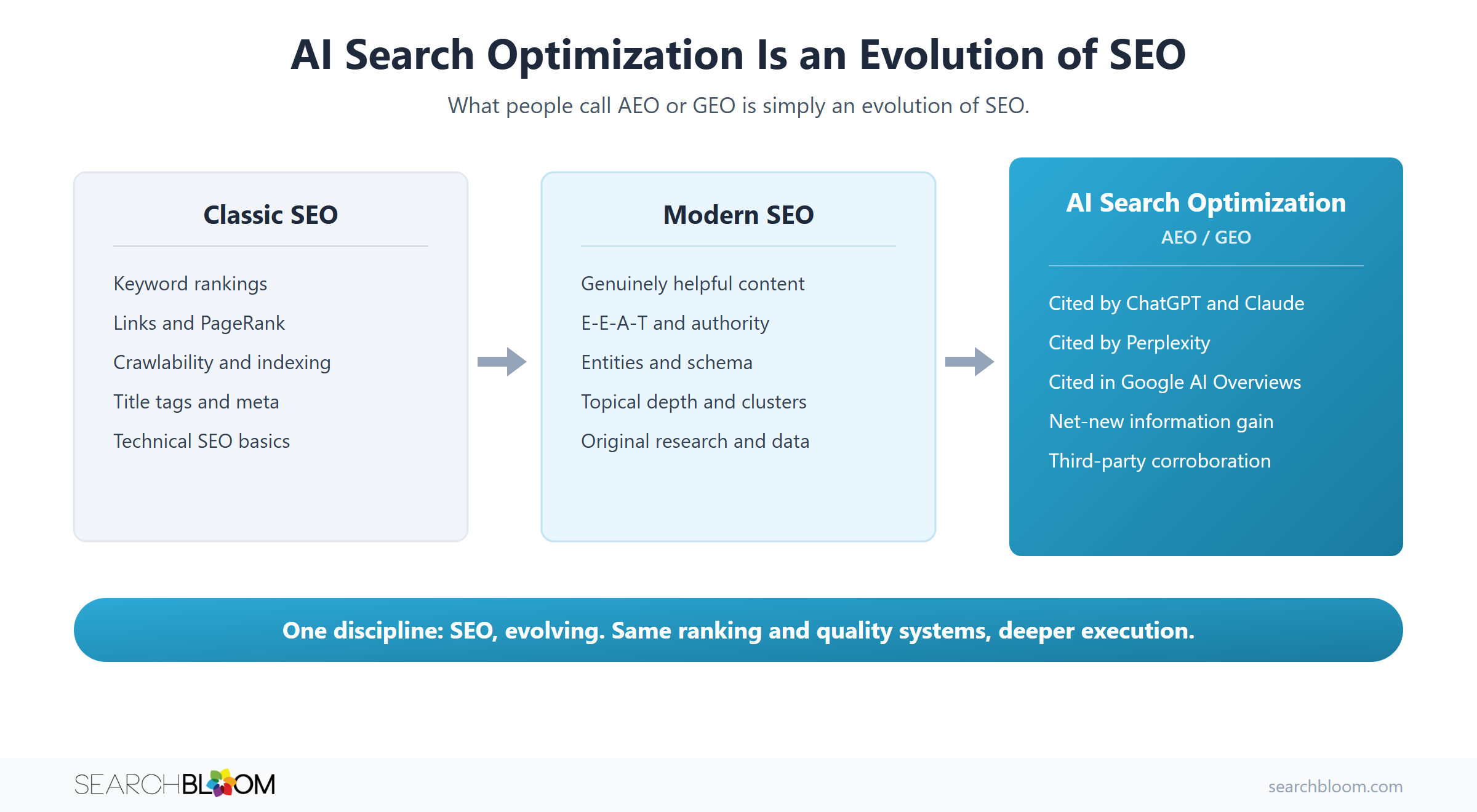
AEO and GEO Are an Evolution of SEO
"I think what people call AEO or GEO is simply an evolution of SEO."
~ Cody C. Jensen, CEO & Founder, Searchbloom
AEO and GEO are not a separate discipline. Google is explicit that its generative AI features are rooted in its core Search ranking and quality systems, so optimizing for generative AI search is optimizing for the search experience, and is still SEO. The same spam and quality policies that govern Search now explicitly govern AI responses. The discipline has evolved, not forked: the same crawlable, authoritative, genuinely helpful content that wins classic Search is what AI retrieval rewards. The overlap is measured, not asserted: Cyrus Shepard's synthesis of 54 experiments, patents, and case studies scored the factors that earn AI citations and found the highest-weighted ones are the same evidence-weighted SEO factors, concluding win SEO and you win AI citations.
What changes is the depth of execution. AirOps's 2026 State of AI Search report found about 60% of AI Overview citations come from URLs that do not rank in the top 20 organic results, because AI retrieval favors deep pages that answer specific subqueries. MERIT is not a replacement for SEO; it is the operating model for executing modern SEO at the depth AI retrieval demands, the part most "AEO" vendors skip while relabeling core SEO. The substrate has not changed, only the surface: as Dan Petrovic puts it, "LLMs have not replaced search. They have simply changed its surface ... LLMs are the presentation layer of AI search." Crawl, index, retrieve, and rank still gate what gets cited.
How SEO Evolved For AI Search
Independent Research Validates the Framework
Research since the October 2025 release reinforces the framework. The primary behavioral data shows continuity, not rupture: Datos State of Search Q1 2026 measures AI tools at under 2% of desktop visits while Google sits at all-time desktop highs, the behavioral case for treating AI search as an evolution to execute rather than a discipline to replace. AirOps's March 2026 analysis (about 15 million data points) aligns directly with MERIT's pillars:
- 85% of brand mentions come from third-party sources, with brands 6.5x more likely to be cited through external content. Validates Mentions.
- Muck Rack's May 2026 analysis of more than 25 million links across ChatGPT, Claude, and Gemini reached 84% from earned third-party sources, a share that has held steady across three editions since July 2025. The largest independent replication of the Mentions premise.
- FAQs are cited at 40% higher odds, clear headings at 2.8x; lists and tables appear in about 80% of ChatGPT citations versus 29% of Google's top results. Validates Relevance.
- About 90% of third-party citations come from listicles, comparisons, and review sites, 80% of cited brands in the top three. Validates Pay-to-Play Placements.
- Rand Fishkin and Patrick O'Donnell (SparkToro and Gumshoe.ai, January 2026) confirmed AI rank volatility: the same leading brands keep resurfacing regardless of phrasing, validating the consideration-set framing in Measurement Cadence.
The convergence is the strongest signal. Nine independent authorities reach the same conclusion from different methods: Michael King from patent reverse-engineering, Dan Petrovic from grounding-pipeline experiments, Cyrus Shepard from a 54-study meta-analysis, Aleyda Solis from a named readiness model, Rand Fishkin from clickstream data, Lily Ray from organic-citation correlation, Andrea Volpini from semantic-infrastructure research, Ben Wills from a 145-industry ranking-factor study, and Kevin Indig from large-sample primary studies all arrive at AI search as an evolution of SEO, not a separate discipline. The primary clickstream dataset states it in its own words: search behavior shows "gradual shifts rather than disruption" with AI "complementary to search" (Datos, State of Search Q1 2026).
Michael King (iPullRank) built the rigorous version of this practice and named it Relevance Engineering, the field's most prominent practitioner renaming the work because the depth of execution changed, not the discipline. What sits in the middle of that overlap is depth, not a label, and MERIT is the operating model for that evolved discipline.
Where leading voices differ, they differ on emphasis, not mechanism, and MERIT holds both sides openly. On content length, Dan Petrovic's grounding-budget data argues density beats length and long-form past roughly 2,000 words dilutes coverage, while MERIT argues a long page structured answer-first per section multiplies its retrieval surface rather than diluting it; treat it as an open, testable question. On scale, Rand Fishkin and Kevin Indig show AI referral traffic is small and, by Indig's data, contracting; MERIT's case deliberately rests on the citation and information-gain layers, not on near-term referral volume, so the calibration sharpens rather than weakens it.
Longpre and co-authors at EMNLP 2021 sharpen the entity-grounding picture with a condition. Retrieved entity evidence drives the answer when the model was trained with strong retrieval, the entity is popular enough to override the parametric prior, and the example sits out of the training set. MERIT's Inclusion case carries that condition openly: entity work pays most where the entity is well-known, the source is high quality, and the entity context reads as plausible.
Recognizing the AEO Relabeling Pattern
A significant portion of services sold as AEO, GEO, or AI SEO is core SEO with a new label. The SEO underneath is sound. What the buyer pays for and does not receive is the depth AI retrieval rewards. Schema, content restructuring, entity work, and crawler configuration retain real value (schema feeds the knowledge graphs AI uses indirectly), but relabeling SEO as AEO does not change what it is. The genuinely AEO-specific work is third-party corroboration, original source assets cited across credible third parties, narrative and reputation alignment across surfaces, and entity-level brand recognition AI can attribute correctly.
The schema case has a primary source: Schema.org's CACM paper from Guha and co-authors records that its annotations feed the Knowledge Graph and supply background facts about well-known entities. Schema work pays in the discovery layer AI reads from, not at the moment of generation.
Recommendations reflect AI search research through May 2026, reviewed August 2026. The field moves fast; verify before adoption. Statistics are from published research (hyperlinked); examples are representative patterns, not specific engagement disclosures.
Conclusion
Final Considerations
AI SEO requires patience and sustained investment. Volatility is high (only 9.2% URL consistency in Google AI Mode, SE Ranking, August 2025), and AI citations decay on their own citation half-life, so success is measured in trends, not short-term swings; expect sustained execution before significant impact. Because AEO and GEO are an evolution of SEO rather than a competing discipline, organizations with strong SEO foundations are best positioned to accelerate AI visibility through these strategies.
The Engineering Shift in Marketing
AI SEO is increasingly engineering-style work: systematic measurement, version-control thinking applied to content, structured data, automated refresh workflows, and AI systems used as production tools. It adds a third dimension alongside creative and strategic judgment, a systems and engineering discipline. This is not a passing trend; the field is professionalizing, and hiring, training, and team structure should reflect that. Kevin Indig's analysis of where capital and effort are flowing reaches the same conclusion: the durable edge is the execution that changes the signal, not the monitoring dashboard (Kevin Indig, Growth Memo, November 2025).
Who Can Execute MERIT
The framework varies in the authority and embedment it requires, which determines whether MERIT is something a team applies itself, hands to a partner, or must restructure to reach:
- In-house teams with full authority can execute the entire framework across marketing, sales, product, PR, and brand. The published citation-lift case studies come from this model. Highest impact.
- Embedded strategic agencies with budget authority and cross-functional reach can execute most of it alongside in-house teams. Uncommon; where the embedment is absent, the agency is constrained to channel-specific chapters (3, 4, 7, 10, 11, 12).
- Consultative advisors can transfer and coach but cannot execute the framework themselves. Useful when the customer has the team and authority to act.
- Tool-only adoption measures visibility but does not move the work. Necessary, not sufficient.
The framework does not require a particular model, but it requires buyers to be honest about which one they have and scope their AEO ambitions accordingly. MERIT closes the widening gap between AEO ambitions and execution capacity by making the dependency between strategy and execution authority explicit.
Sources & Further Reading
Core research referenced in this whitepaper. The Playbook sources page carries the full citation set. All links open in a new tab.
Industry Research
- seoClarity (October 2025): 97% of AI Overviews cite at least one source from the top 20 organic results.
- SE Ranking (August 2025): Only 9.2% URL consistency in Google AI Mode across repeated searches.
- Profound via Axios (October 2025): Over 1 billion citations analyzed across ChatGPT, Google AI Overviews, Perplexity, and seven other AI engines.
- SparkToro (January 2026): 2,961 prompts documenting consideration-set stability versus rank randomness.
- AirOps AI Search Playbook (March 2026): About 15 million data points on AI answers, citations, and brand mentions; companion structure, offsite-signal, and freshness studies.
- Datos, State of Search Q1 2026: Primary desktop clickstream across the US, EU, and UK; the dataset's own conclusion is gradual shifts rather than disruption, with AI tools still under 2% of desktop visits.
- Muck Rack, What Is AI Reading (May 2026): More than 25 million links across ChatGPT, Claude, and Gemini; 84% from earned, third-party sources, holding steady across three editions since July 2025.
- Ben Wills, LLM Ranking Factors (March 2026): 145 industries, 1,595 personas, and more than 105,000 LLM prompts measuring category-specific signal patterns.
Public Case Studies
- Carta: 7x increase in AI citations, 75% citation rate on newly published pages.
- Webflow: 5x refresh velocity, 6x conversion rate from AI-sourced traffic.
- Chime: 89% time reduction per refresh, AI citations tripled shortly after systematic refresh deployment.
- Docebo: 25% share of voice lead, doubled publishing velocity without adding headcount.
Tools & Vendors Mentioned
Pricing last verified April 2026 and subject to change; confirm current pricing with each vendor. Inclusion is not endorsement; verify before adoption.
Brand Mention Monitoring
- Alertmouse: Mention monitoring across news, blogs, and social. Co-founded by Rand Fishkin (SparkToro). Free (1 alert); Basic from $10/month.
- Ahrefs Firehose: Real-time web monitoring API (SSE, Lucene syntax). Free tier available. For developer and automation workflows.
- Ahrefs Alerts: Brand and keyword tracking within the Ahrefs platform.
AI Visibility Measurement
- Profound AI: Multi-platform citation tracking. From $499/month (4 platforms).
- Peec AI: 115+ language support. From EUR89/month.
- Semrush AI Toolkit: AI visibility plus traditional SEO data. $120 to 500/month.
- Writesonic GEO, Promptmonitor, Otterly.AI: Budget-tier options.
Indexing & Discovery
- IndexNow: Open-source instant index notification. Free.
- Cloudflare Crawler Hints: CDN-level IndexNow integration.
Questions & Answers
What is AI SEO?
AI SEO is the practice of earning visibility in large language models like ChatGPT, Claude, Perplexity, Google AI Overviews, and Gemini. It is search optimization evolved for AI retrieval, and it spans two related disciplines: Answer Engine Optimization (AEO), the work of being the cited answer to a question, and Generative Engine Optimization (GEO), the broader work of being both cited and recommended across generative AI. Unlike traditional SEO, which targets ranking in search engine results, AI SEO focuses on being cited and recommended when AI systems generate responses. The MERIT Framework provides a structured methodology for AI SEO across fifteen chapters and five pillars.
How does AI SEO differ from traditional SEO?
It does not fork from SEO; it is an evolution of it. Google is explicit that its generative AI features are rooted in its core Search ranking and quality systems, so optimizing for generative AI search is still SEO. Traditional SEO targets result rankings; AI SEO targets being cited in AI-generated responses, but the underlying work is the same crawlable, authoritative, genuinely helpful content. Schema and E-E-A-T originated as SEO factors and still matter there; their effect on AI visibility is indirect, arriving through the search-index layer retrieval-augmented generation draws on, and in schema's case it is small (iPullRank's GEO Core chapter documents how structured signals help generative engines disambiguate entities). What changes is the depth of execution: the third-party corroboration, original source assets, and narrative and reputation alignment that MERIT operationalizes are the part most AEO vendors skip while relabeling core SEO.
What are AI SEO strategies?
The MERIT Framework organizes fifteen AI SEO chapters across five pillars. Mentions covers third-party validation through review platforms, community engagement, and earned media. Evidence covers original source assets that AI cites. Relevance covers content structured for AI retrieval. Inclusion covers technical accessibility for AI crawlers and entity recognition. Transformation covers measurement, sentiment management (measure the footprint, then shape it), and organizational evolution. Each chapter is documented with supporting research and representative examples.
How do you measure ROI from AI SEO?
AI SEO ROI is measured through citation rate (frequency of brand citations across major AI engines), share of voice in AI responses, sentiment in AI outputs, AI-referred traffic, and conversion rates from AI-sourced visitors. Tools like Profound AI, Peec AI, Otterly, and Semrush AI Toolkit support periodic audits across ChatGPT, Claude, Perplexity, Gemini, and Google AI Overviews. Because AI citation patterns are volatile, ROI is best evaluated as thirty-day or ninety-day moving averages rather than week-to-week measurements. Chapter 13 (Measurement Cadence) covers the full measurement methodology.
Who should do AI SEO?
Best executed by in-house teams with full authority across marketing, sales, product, PR, and brand. Embedded strategic agencies can execute most of it with in-house teams; consultative advisors transfer methodology but do not execute; tool-only adoption measures without moving the work. The "Who Can Execute MERIT" section above details the four execution-authority levels.
Cody C. Jensen
CEO & Founder of Searchbloom
Cody C. Jensen is CEO & Founder of Searchbloom, a results-driven search engine marketing agency. He began his career at Google and later advanced through some of the largest agencies in the digital marketing industry. During that time, he recognized the need for an agency that focused on transparency, measurable results, and ethical practices.
Searchbloom was his answer, created with the mission to be the most trusted, transparent, and results-driven search marketing agency in the industry. Cody works closely with marketing executives, digital managers, business owners, and enterprise brands to create full-funnel strategies that deliver real growth.
His leadership and innovation have led to the development of proven digital marketing methodologies that continue to help Searchbloom's partners achieve lasting ROI and sustainable success.
